
公共卫生学术热点追踪
Nature Human Behaviour | 四川大学华西医院及四川省人民医院团队揭示二手烟危害剂量-反应证据链
吸烟是全球首要的可预防死亡原因,每年导致超过800万人死亡。然而,吸烟的危害并不局限于吸烟者自身,二手烟暴露(Secondhand smoke exposure, SHSE),亦称被动吸烟或非自愿吸烟,是指非吸烟者暴露于吸烟者释放的环境烟草烟雾(Environmental tobacco smoke, ETS)中。据全球疾病负担(GBD)2019年评估,二手烟暴露每年约造成129万人死亡和3490万伤残调整生命年(DALYs),且相关伤残寿命年(YLDs)在过去三十年间几乎翻倍,疾病负担不成比例地集中于中低收入国家1,2。
过去数十年间,流行病学、毒理学和临床研究反复证实二手烟暴露与多种不良健康结局相关,科学共识已经形成3。然而,现有证据仍存在碎片化和方法学不一致的问题——不同研究在暴露场景(家庭、工作场所)、生命历程阶段(胎儿期、儿童期、成年期)、暴露强度和时长、以及脆弱人群定义等方面差异显著,导致已有的系统评价难以在统一框架下进行比较整合。更为关键的是,科学共识并未完全转化为全球范围内的公共卫生成效,证据与实践之间仍存在鸿沟4。
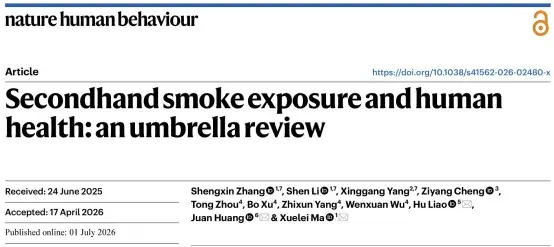
近日,四川大学华西医院生物治疗科马学磊研究员团队联合胸外科廖虎研究员团队、四川省人民医院黄娟研究员团队在Nature Human Behaviour杂志在线发表了题为“Secondhand smoke exposure and human health: an umbrella review”的伞状综述研究。 该研究由四川大学华西医院生物治疗科张圣欣、李燊及呼吸与呼吸与危重症医学科杨兴刚担任共同第一作者。研究团队通过对111篇系统评价与Meta分析进行系统性再分析,在统一的方法学框架下重新评估了二手烟暴露相关的健康风险,涵盖约2.53亿参与者、130种健康结局和226个独立关联,构建了从胎儿发育到儿童期再到成年期全生命周期的证据地图。
伞状综述(Umbrella Review)的优势在于能够在统一、标准化的方法学框架内,对碎片化甚至不一致的证据进行再评估和分级,从而减少因方法学差异和证据重叠带来的偏倚。研究团队系统检索了PubMed、Cochrane Library、Web of Science和Embase四大数据库(截至2025年8月24日),经严格筛选后最终纳入111篇系统评价与Meta分析进行再分析。为统一各研究间异质性的定义,团队将二手烟暴露归纳为10种暴露-人群场景,包括产前母亲吸烟、产前母亲二手烟暴露、家庭吸烟暴露、工作场所暴露等(图1)。证据质量采用AMSTAR 2评估方法学质量,并结合证据分类标准(Class I-IV)、失安全系数(Fail-safe Number, FSN)和GRADE框架进行多维度的可信度与稳健性评价。
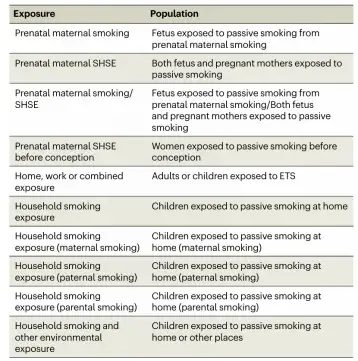
图1.二手烟相关暴露种类及其影响人群
不良妊娠结局与先天性畸形:生命早期的脆弱窗口
研究揭示了产前二手烟暴露对胎儿发育的深远影响。Class I(令人信服)的证据表明,产前母亲每日吸烟11-19支与婴儿低出生体重风险显著增加相关(OR = 2.05, 95% CI 1.89–2.23, k = 7, p < 0.001),且原始文献中的剂量-反应Meta分析进一步揭示非线性关联:与不吸烟母亲相比,每日吸烟5支、15支和25支对应的低出生体重OR分别为1.65、1.92和2.905;这表明了即使在低暴露水平下,风险也呈进行性增加。
Class II(高度提示性)证据表明,产前母亲吸烟与胎儿围产期死亡风险增加相关(RR = 1.33, 95% CI 1.24-1.42, k = 46, p < 0.001),同样展现非线性剂量-反应关系6。值得注意的是,即使母亲本人不吸烟,仅产前二手烟暴露(如父亲吸烟)也与胎儿先天性心脏缺陷风险显著增加相关(RR = 2.31, 95% CI 1.75-3.07, k = 36, Class II证据),这一发现对于无吸烟习惯但处于二手烟环境中的孕妇具有重要警示意义7。
循环与呼吸系统疾病:无安全暴露水平
在成人慢性病领域,二手烟暴露同样是不可忽视的贡献因素。Class II证据表明,二手烟暴露与总体心血管疾病风险显著增加相关(OR = 1.24, 95% CI 1.16-1.31, k = 52, p < 0.001),且剂量-反应关系在多项暴露指标中均得到验证:每增加5支/天的暴露强度、每增加5年暴露时长、每增加10包年的累积暴露量,CVD风险均呈线性递增8。类似地,Class II证据显示二手烟暴露与脑卒中风险增加(RR = 1.24, 95% CI 1.16–1.32, k = 38, p < 0.001)相关9。这些发现支持了“二手烟无安全暴露水平”的论断,表明即便是低水平的长期二手烟暴露也可能造成显著的心血管损伤。
在呼吸系统方面,Class II证据表明儿童期家庭二手烟暴露与哮喘(OR = 1.28, 95% CI 1.21-1.36, k = 45, p < 0.001)和喘息(OR = 1.37, 95% CI 1.27-1.49, k = 17, p < 0.001)风险增加相关,此外还与慢性咳嗽(OR = 1.44, Class II)和阻塞性睡眠呼吸暂停(RR = 1.51, Class II)显著相关10-12。
癌症:肺癌证据最为确凿,多癌种呈现剂量-反应趋势
在癌症领域,Class II证据明确显示二手烟暴露与肺癌风险增加相关(RR = 1.24, 95% CI 1.16-1.32, k = 82, p < 0.001),且呈现清晰的剂量-反应关系:暴露于二手烟强度为每天10支烟与肺癌风险增加10%相关(RR = 1.10,95% CI 1.03-1.17);二手烟暴露持续10年与风险增加20%相关(RR = 1.20,95% CI 1.13-1.28);二手烟暴露累积20包年与风险增加16%相关(RR = 1.16,95% CI 1.07-1.25)13。这进一步强化了二手烟作为Group 1致癌物的公共卫生关切14。Class III证据提示二手烟暴露还与乳腺癌(RR = 1.25, 95% CI 1.15-1.36, k = 52)、宫颈癌(RR = 1.53, 95% CI 1.27-1.83, k = 21)风险增加相关,且均观察到剂量-反应趋势15,16。
神经精神与代谢疾病:新兴证据领域
证据还揭示了二手烟暴露与心理健康之间的关联。Class II证据显示,二手烟暴露与抑郁症状风险增加显著相关(OR = 1.39, 95% CI 1.28-1.51, k = 24, p < 0.001),且关联强度随暴露频率增加而递增17。而在代谢领域,Class I/II证据表明产前母亲吸烟与后代超重/肥胖风险增加显著相关,且存在明确的剂量-反应关系18-20。
证据全景:Class I/II健康结局证据汇总
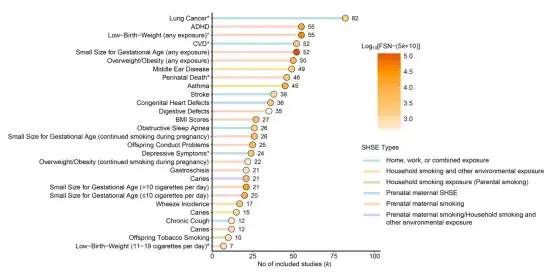
图2:Class I/II证据汇总概览图
图2以水平柱状图展示了所有达到Class I/II证据等级的健康结局,柱长代表该Meta分析纳入的原始研究数量(k),颜色区分二手烟暴露类型(产前母亲吸烟、家庭吸烟暴露、家庭+其他环境暴露等)。叠加球体代表统计稳健性(log10[FSN−(5k+10)]),颜色越深表示稳健性越高。图中清晰显示肺癌、心血管疾病、脑卒中、低出生体重、小于胎龄儿、围产期死亡、消化系统缺陷、先天性心脏缺陷、哮喘、喘息、慢性咳嗽、阻塞性睡眠呼吸暂停、抑郁症状、ADHD、超重/肥胖、龋齿、中耳疾病、子女烟草吸烟行为、子女行为问题等28个结局的FSN远超保守阈值(5k+10),统计稳健性较强。
从证据到行动:区分“已知”与“未知”
本研究的一大创新在于不仅梳理了“已知”,更系统界定了“未知”。研究团队对87项未达统计学显著性的关联进行了前瞻性场景分析(Prospective Scenario Analysis),估算在保守或乐观情景下需要多少新增研究才能使结论达到统计学显著性。分析发现,50项关联即使在保守情景下也需要比现有研究数量更多的新研究才能推翻零假设,提示这些领域可能不值得投入大量研究资源;而29项关联(33.3%)仅需0-1项新增研究即可排除零假设,这些领域(如某些先天性疾病的二手烟关联、高血压、哮喘急性加重等)应作为未来研究的优先方向。
此外,研究提出了“证据饱和区”的概念,即当某一研究领域在结论一致性、统计稳健性和未来前瞻性研究的增量证据潜力三个维度上均趋于饱和时,研究重点应从“确认危害”转向“推动危害减少”。例如,二手烟与肺癌的关联已得到高度提示性证据和极高FSN值的支持,未来资源应更集中于实施科学(Implementation Science),探索如何将已知健康风险转化为有效的公共卫生政策21。
总体来讲,该伞状综述系统整合了二手烟暴露与130种健康结局的流行病学证据,发现二手烟对多器官系统(包括妊娠、呼吸、循环、代谢、癌症及精神神经等方面)均有广泛危害,孕妇、胎儿和儿童等脆弱群体风险尤其突出。剂量-反应关系的存在进一步支持了“无安全暴露水平”的科学论断。研究还为MPOWER政策中的监测(M)和保护(P)提供了证据支撑,既可用于评估控烟效果,也可作为政策倡导依据。文章最后强调,当前的核心问题已不再是证明“有害”,而是如何将证据有效转化为公共卫生政策和干预措施,以切实保障全体人群的健康。
(来源:生物谷)
参考文献:
1 Su, Z. et al. Second hand smoke attributable disease burden in 204 countries and territories, 1990–2021: a systematic analysis from the Global Burden of Disease Study 2021. Respiratory research 26, 174, doi:10.1186/s12931-025-03228-3 (2025).
2 Zhai, C. et al. Global, regional, and national deaths, disability-adjusted life years, years lived with disability, and years of life lost for the global disease burden attributable to second-hand smoke, 1990–2019: A systematic analysis for the Global Burden of Disease Study. Science of The Total Environment 862, 160677, doi:https://doi.org/10.1016/j.scitotenv.2022.160677 (2023).
3 Arfaeinia, H., Ghaemi, M., Jahantigh, A., Soleimani, F. & Hashemi, H. Secondhand and thirdhand smoke: a review on chemical contents, exposure routes, and protective strategies. Environmental Science and Pollution Research 30, 78017-78029, doi:10.1007/s11356-023-28128-1 (2023).
4 Reitsma, M. B. et al. Spatial, temporal, and demographic patterns in prevalence of smoking tobacco use and attributable disease burden in 204 countries and territories, 1990–2019: a systematic analysis from the Global Burden of Disease Study 2019. The Lancet 397, 2337-2360, doi:https://doi.org/10.1016/S0140-6736(21)01169-7 (2021).
5 Di, H.-K. et al. Maternal smoking status during pregnancy and low birth weight in offspring: systematic review and meta-analysis of 55 cohort studies published from 1986 to 2020. World Journal of Pediatrics 18, 176-185, doi:10.1007/s12519-021-00501-5 (2022).
6 Pineles, B. L., Hsu, S., Park, E. & Samet, J. M. Systematic Review and Meta-Analyses of Perinatal Death and Maternal Exposure to Tobacco Smoke During Pregnancy. American journal of epidemiology 184, 87-97, doi:10.1093/aje/kwv301 (2016).
7 Zhao, L. et al. Parental smoking and the risk of congenital heart defects in offspring: An updated meta-analysis of observational studies. European Journal of Preventive Cardiology 27, 1284-1293, doi:10.1177/2047487319831367 %J European Journal of Preventive Cardiology (2020).
8 Zhang, D. et al. Dose-related effect of secondhand smoke on cardiovascular disease in nonsmokers: Systematic review and meta-analysis. International Journal of Hygiene and Environmental Health 228, 113546, doi:https://doi.org/10.1016/j.ijheh.2020.113546 (2020).
9 Lv, X. et al. Risk of all-cause mortality and cardiovascular disease associated with secondhand smoke exposure: A systematic review and meta-analysis. International Journal of Cardiology 199, 106-115, doi:https://doi.org/10.1016/j.ijcard.2015.07.011 (2015).
10 He, Z. et al. The association between secondhand smoke and childhood asthma: A systematic review and meta-analysis. Pediatric pulmonology 55, 2518-2531, doi:10.1002/ppul.24961 (2020).
11 Liang, H. et al. Risk factors of chronic cough in China: a systematic review and meta-analysis. Expert review of respiratory medicine 16, 575-586, doi:10.1080/17476348.2022.2049759 (2022).
12 Chang, C. W. et al. What is the association between secondhand smoke (SHS) and possible obstructive sleep apnea: a meta-analysis. Environmental health : a global access science source 21, 58, doi:10.1186/s12940-022-00868-6 (2022).
13 Possenti, I. et al. Association between second-hand smoke exposure and lung cancer risk in never-smokers: a systematic review and meta-analysis. European respiratory review : an official journal of the European Respiratory Society 33, doi:10.1183/16000617.0077-2024 (2024).
14 Tobacco smoke and involuntary smoking. IARC monographs on the evaluation of carcinogenic risks to humans 83, 1-1438 (2004).
15 Possenti, I. et al. Exposure to second-hand smoke and breast cancer risk in non-smoking women: a comprehensive systematic review and meta-analysis. British journal of cancer 131, 1116-1125, doi:10.1038/s41416-024-02732-5 (2024).
16 Malevolti, M. C. et al. Second-hand smoke exposure and cervical cancer: a systematic review and meta-analysis. Journal of cancer research and clinical oncology 149, 14353-14363, doi:10.1007/s00432-023-04841-9 (2023).
17 Han, C., Liu, Y., Gong, X., Ye, X. & Zhou, J. Relationship Between Secondhand Smoke Exposure and Depressive Symptoms: A Systematic Review and Dose⁻Response Meta-Analysis. International journal of environmental research and public health 16, doi:10.3390/ijerph16081356 (2019).
18 Philips, E. M. et al. Changes in parental smoking during pregnancy and risks of adverse birth outcomes and childhood overweight in Europe and North America: An individual participant data meta-analysis of 229,000 singleton births. PLoS medicine 17, e1003182, doi:10.1371/journal.pmed.1003182 (2020).
19 Magalhães, E., Sousa, B. A., Lima, N. P. & Horta, B. L. Maternal smoking during pregnancy and offspring body mass index and overweight: a systematic review and meta-analysis. Cadernos de saude publica 35, e00176118, doi:10.1590/0102-311x00176118 (2019).
20 Albers, L. et al. Maternal smoking during pregnancy and offspring overweight: is there a dose-response relationship? An individual patient data meta-analysis. International journal of obesity (2005) 42, 1249-1264, doi:10.1038/s41366-018-0050-0 (2018).
21 Chalmers, I. & Glasziou, P. Avoidable waste in the production and reporting of research evidence. Lancet (London, England) 374, 86-89, doi:10.1016/s0140-6736(09)60329-9 (2009).
链接:https://pubmed.ncbi.nlm.nih.gov/42386914/